Wool and Memory: The Last Sheepherding Families of Montana's High Country
Wool and Memory: The Last Sheepherding Families of Montana's High Country
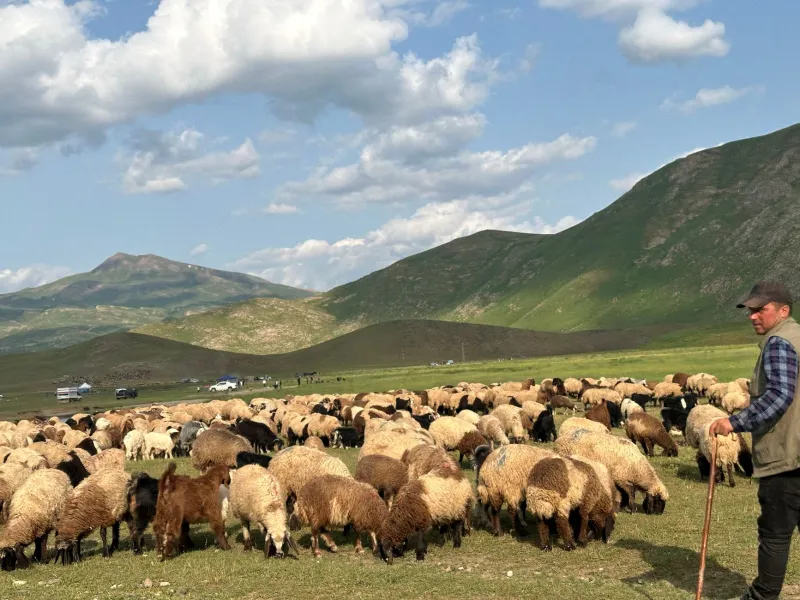
On a ridge above the Bitterroot Valley, where the wind comes in sideways and the nearest paved road is a forty-minute drive downhill, Jon Arrizabalaga watches a band of roughly eight hundred sheep move across a slope that his grandfather worked before him. The animals flow like water through the dry grass, guided by a pair of border collies and a herder who has spent more nights under canvas than under a roof. Arrizabalaga, sixty-one, has no illusions about what he is witnessing — not just a workday, but possibly the last chapter of something.
"My grandfather came from the Basque country with almost nothing," he says, not taking his eyes off the flock. "He thought sheep were the future of Montana. He wasn't wrong, for a long time."
For a long time is doing a great deal of work in that sentence.
A History Written in Wool
Montana's sheep industry once rivaled its cattle trade in both scale and cultural significance. At its peak in the early twentieth century, the state counted more than three million sheep on its ranges — a number that placed it among the top wool-producing states in the nation. The herders who tended those flocks came largely from outside the American mainstream: Basque immigrants from the Pyrenees borderlands of Spain and France, Scottish Highland families who recognized familiar terrain in Montana's rougher country, and, beginning in the mid-twentieth century, Peruvian men who arrived on temporary agricultural visas and often stayed for decades.
Each group brought its own methods, its own language, and its own relationship to the land. The Basques settled heavily in the Bitterroot and Judith Basin regions. Scottish families put down roots in the Beartooth foothills. Peruvian herders, many of them from the high Andean plateau, found that Montana's elevation and cold presented challenges they understood instinctively.
What they shared was a willingness to live alone for months at a stretch in conditions most Americans would find intolerable, moving constantly with their animals across terrain that resisted everything else.
Today, the Montana Wool Growers Association estimates that the state's sheep population has fallen below two hundred thousand — a decline of more than ninety percent from its historical high. The families still in the business can nearly be counted on two hands.
The Economics of Disappearance
The reasons for that collapse are not mysterious, though they are layered in ways that resist simple explanation.
Wool prices collapsed in the 1990s following the elimination of federal price supports, a policy shift that gutted the economic foundation of operations that had survived for generations. Synthetic fibers had already been eroding the market for decades, and the removal of the support program — which had effectively subsidized domestic wool production since World War II — pushed many families to the edge and over it.
Lamb prices have recovered somewhat in recent years, driven by demand from immigrant communities in American cities who prize fresh domestic lamb over frozen imports. But the margin remains thin, and the infrastructure that once supported the industry — shearing crews, wool warehouses, processing facilities — has largely disappeared along with the flocks it served.
"When I need shearing done, I'm calling people from out of state, sometimes out of the country," says Maria Etcheverry, who runs a small operation in the Judith Basin with her husband and their adult son. "The knowledge is going away faster than the animals are."
Labor presents an equally serious challenge. The herder's life — solitary, physically demanding, poorly compensated by modern standards — attracts few American workers. Operations like the Arrizabalagasʼ have long depended on the H-2A agricultural visa program to bring Peruvian herders to Montana each season. But that program has grown increasingly complicated to navigate, and the herders themselves now have more options than they once did, both in Peru and elsewhere in the United States.
Predators and Politics
No conversation about Montana sheepherding goes very long before it turns to wolves.
The reintroduction of gray wolves to the Northern Rockies beginning in the mid-1990s transformed the predator landscape across the state, and sheep operations absorbed a disproportionate share of the impact. Unlike cattle, which can sometimes defend themselves or are large enough to deter attack, sheep are vulnerable in ways that frustrate even experienced herders.
"You can do everything right — good dogs, good fencing where you can fence, a herder on the ground — and still lose animals," says Arrizabalaga. "And then you spend months trying to document it well enough to get compensated, and sometimes you do and sometimes you don't."
Compensation programs administered through organizations like the Montana Department of Livestock and various conservation nonprofits have improved over the years, but ranchers argue that reimbursement rarely accounts for the full cost of a predation event — including stressed animals that fail to gain weight, ewes that lose pregnancies, and the cumulative toll on a herder's ability to manage a band effectively.
The politics surrounding wolf management remain deeply contentious in Montana, with livestock producers and wildlife advocates frequently at odds over population targets, hunting quotas, and the adequacy of depredation response. For sheepherders operating on narrow margins, the debate can feel abstract when measured against the concrete reality of a dead animal on the ground.
Grizzly bears, mountain lions, and coyotes add further complexity. "People think it's just wolves," says Etcheverry. "It's everything. It's always been everything. But the pressure has increased, and the support hasn't kept up."
What Is Lost When the Flocks Go Silent
Beyond the economic and ecological dimensions of the industry's decline lies a quieter loss — one that is harder to quantify but no less real to the families living through it.
The Basque community in particular has maintained a distinctive cultural presence in parts of Montana that is directly tied to the sheepherding tradition. Festivals, language preservation efforts, and family networks all grew from the original migration of herders who came to work the range and eventually built communities around that work. As the operations close and the younger generations move toward other careers, the connective tissue of that culture stretches thin.
"My kids love this place," says Arrizabalaga, gesturing toward the ridge and the valley below it. "But I don't know if they love it enough to do what it takes. And I don't know if I'd want them to, honestly. It's a hard life."
That ambivalence — pride in the tradition, uncertainty about its future, reluctance to demand sacrifice from the next generation — runs through nearly every conversation with the families still in the business. None of them are quitting. Most of them are not sure who comes after them.
The sheep move steadily across the hillside as the afternoon light shifts toward gold. The dogs work the edges of the band with quiet efficiency. Somewhere below, the world is moving at a different pace entirely, largely unaware that this is happening at all.
"People in Billings or Missoula, they don't think about where their lamb chop comes from," Arrizabalaga says. "They don't think about this. Maybe that's fine. But somebody has to be up here. And pretty soon, I'm not sure who that's going to be."
The answer to that question, if there is one, will be written not in policy documents or market reports, but in the decisions made by a small number of families working some of the most unforgiving country in the American West — families who have already refused to quit more times than they can count.