Voice at the End of the Line: Montana's Last Manual Telephone Operators Hold the World Together
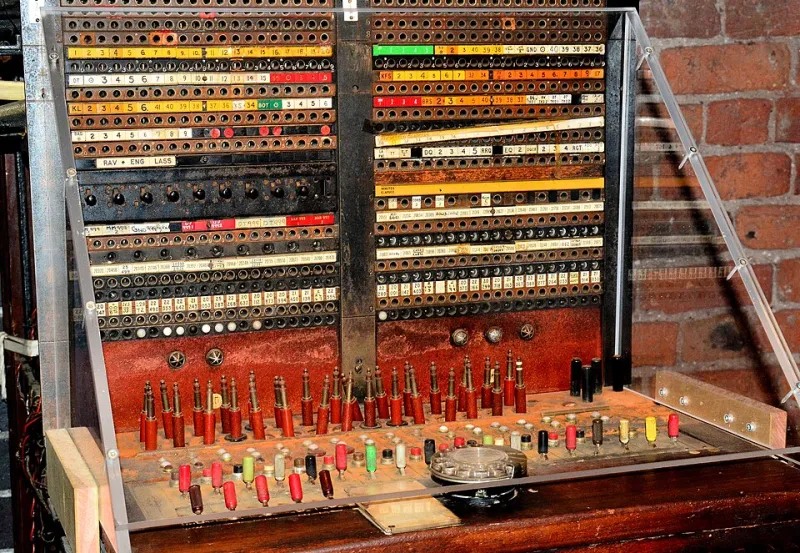
Photo: Mike McBey, CC BY 2.0, via Wikimedia Commons
On a Tuesday morning in late October, with frost still clinging to the pasture grass outside her window, Elaine Hofer picks up the headset she has worn for thirty-one years and says what she always says: "Good morning. How can I connect you?" The answer, in the small ranching community where she works, is rarely simple.
Hofer is one of a vanishingly small number of manual telephone operators still active in the state of Montana. She does not work for a large telecommunications company. She works for a rural telephone cooperative that has, so far, resisted the full automation that consumed most of the industry decades ago. Her switchboard is not a museum piece — it is a functioning piece of infrastructure, and on most days, it is busier than people outside these communities might expect.
A Different Kind of Infrastructure
When most Americans think about telephone operators, they think of black-and-white photographs and mid-century television dramas. In Montana's most isolated corners, the image is more complicated. Rural telephone cooperatives, many of them established in the 1950s under federal rural electrification programs, built communication networks across terrain that private companies considered unprofitable. Some of those cooperatives modernized rapidly. Others, serving communities so sparse that automation offered little economic advantage over the existing arrangement, kept human operators in place longer than anyone anticipated.
The result is a small but stubbornly persistent class of workers who know their subscribers by name, by voice, and often by circumstance. They know which rancher has a heart condition and which family's teenager just left for college. They know when a regular caller has not checked in for two days, and they know what that silence might mean.
"People call me for a lot of things that have nothing to do with connecting a call," Hofer says, her tone matter-of-fact rather than sentimental. "They call to ask if the road to the highway is passable. They call to find out if the feed store is open. Sometimes they just call because they haven't talked to anyone since yesterday."
The Knowledge That Cannot Be Uploaded
Telephone operators in remote Montana function as something closer to community coordinators than to telecommunications workers in any conventional sense. The institutional knowledge they accumulate over years of service is not stored in any database. It lives, entirely, in memory.
Roger Dunlap, who manages a rural cooperative in central Montana, has watched his operator workforce shrink from four people to one over the past fifteen years. He speaks carefully when asked about the timeline for full automation. "We have looked at it," he says. "The economics are not straightforward. When you factor in the cost of upgrading infrastructure in areas with very low subscriber density, and you factor in what the operator actually does for this community beyond routing calls, the calculation is not as simple as it appears on paper."
What the operator does, in practical terms, includes maintaining informal emergency awareness. Several operators in Montana describe alerting emergency services — or simply a neighbor — when a call came in that suggested something was wrong but the caller could not or did not articulate the problem directly. No automated system performs that function.
"A recording cannot hear the difference between a voice that sounds fine and a voice that sounds scared," says one operator who asked not to be identified by name. "I can."
When the Board Goes Dark
The trajectory is not in doubt. Telecommunications regulators, federal subsidy structures, and the basic economics of rural infrastructure all point toward the same outcome. Manual operators will eventually be replaced, either by automated switching systems or by the consolidation of cooperatives into larger regional networks that have no place for individualized human service.
For the communities that depend on these operators, the transition raises questions that go beyond telephone service. The operators serve, in many cases, as the only consistent point of human contact between isolated households and the wider world. Replacing that contact with an automated menu does not merely change how calls are routed — it removes a person from the community's daily life.
Elaine Hofer does not spend much time worrying about her own future. She is sixty-three years old and has a clear-eyed view of how this ends. What concerns her more is the period of adjustment for the people she currently serves. "There are people on my lines who have been talking to me for twenty-five years," she says. "When I'm gone, they're not just losing an operator. They're losing somebody who knows them."
She pauses, then adds something that functions less as a complaint than as an observation: "A computer won't know that Harold always calls at 7:15 to check on his sister. It won't notice if he stops."
A Quietly Disappearing Profession
The Montana Public Service Commission does not track manual telephone operators as a distinct employment category. No state agency maintains a comprehensive count of how many remain active. The number is almost certainly in the single digits, and it is declining.
What those remaining operators represent, beyond their immediate function, is a design philosophy that once governed rural communication across the American West — the idea that a network is not merely technical infrastructure but a social one, and that the human being at its center carries value that cannot be fully automated away.
Whether that philosophy survives contact with the economics of the twenty-first century is a question Montana's most remote communities will not have to answer in the abstract. They will answer it the morning the switchboard finally goes dark and the phone rings into a recording that does not know their name.