Timber, Memory, and Neglect: The Race to Save Montana's Forgotten Forest Service Cabins
Timber, Memory, and Neglect: The Race to Save Montana's Forgotten Forest Service Cabins
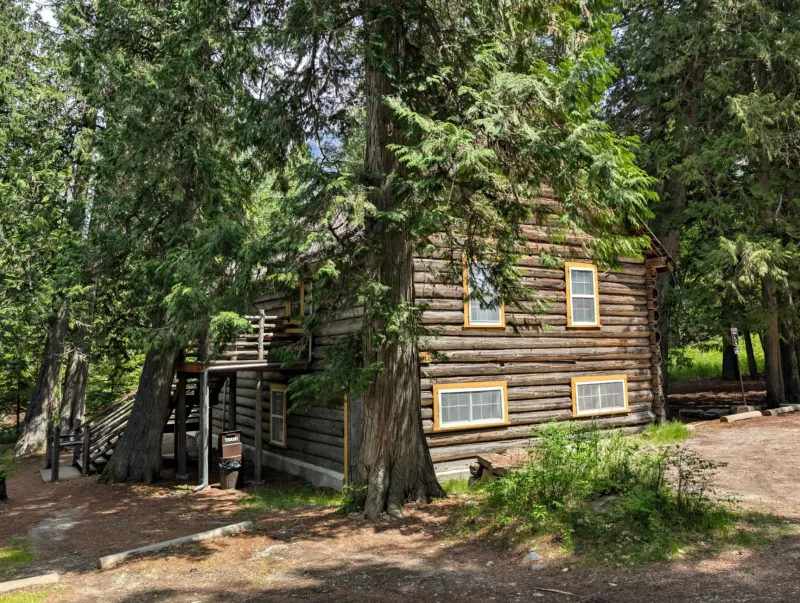
The cabin sits at the end of a trail that most maps no longer bother to mark. Its log walls have darkened to the color of charcoal, the chinking between timbers has crumbled in long, pale strips, and the roof sags at the center like an old man's shoulders. A hand-forged latch still hangs on the door. Inside, a cast-iron stove and a single wooden bunk frame remain, as if whoever last slept there simply stepped out and never returned.
This is one of roughly 200 historic Forest Service cabins still standing across Montana's national forests. Built primarily during the 1930s by Civilian Conservation Corps crews and early Forest Service rangers, they once formed the backbone of a wilderness management system—outposts for firefighters, range riders, and surveyors working some of the most remote terrain in the American West. Today, many of those same structures are in an advanced state of decay, their futures uncertain and their stories largely untold.
A Century of Service, Decades of Decline
The Forest Service began constructing permanent backcountry infrastructure in Montana as early as the 1910s, accelerating dramatically during the Depression when federal work programs flooded the mountains with labor. Ranger stations, patrol cabins, guard stations, and fire lookouts rose from the timber in valleys and on ridgelines throughout the Bitterroot, Flathead, Lolo, and Gallatin national forests, among others.
For much of the twentieth century, these structures were maintained as functional assets—used seasonally by agency personnel and, in some cases, made available to the public through permit rental programs. But as the Forest Service's workforce shrank and its maintenance backlog ballooned, many cabins fell into a gray zone: too historic to demolish without controversy, too expensive to restore without dedicated funding, and too remote to attract consistent attention.
The agency's own deferred maintenance liability across all national forests now runs into the billions of dollars nationally. In Montana alone, historic structures account for a significant portion of that burden. Without intervention, preservationists say, many of these cabins will reach a point of no return within the next decade.
Volunteers Stepping Into the Gap
Where the federal government has struggled to act, a loosely organized network of volunteers, historical societies, and nonprofit groups has stepped forward—sometimes with agency blessing, sometimes through sheer persistence.
Organizations such as the Montana Preservation Alliance and various local historical trusts have partnered with individual national forests to conduct condition assessments, photograph interiors, and in some cases fund targeted stabilization work. Volunteer crews have re-chinked walls, replaced rotted floorboards, and shored up failing foundations at a handful of high-priority sites.
The work is painstaking and, by the standards of professional construction, chronically underfunded. A single cabin restoration can cost anywhere from $30,000 to well over $150,000 depending on its condition and accessibility. Grant funding through the National Park Service's Historic Preservation Fund and the Land and Water Conservation Fund has helped in isolated cases, but advocates say the pace of preservation lags far behind the pace of deterioration.
"We're in a race we didn't choose," said one preservation volunteer who has spent more than a decade documenting backcountry structures in western Montana. "Every winter that passes without intervention is another winter these buildings may not survive."
What the Records Say—and What They Don't
Documentation has become as urgent a priority as physical restoration. Many of the cabins were built without formal architectural drawings, and the institutional knowledge of their construction—which crews built them, what techniques they used, where the timber was sourced—exists only in fragmentary form across scattered agency files, retired employees' memories, and local historical collections.
Historians working with the Forest Service have identified a number of structures that qualify for listing on the National Register of Historic Places, a designation that can unlock additional preservation funding and impose greater legal protections against demolition. Progress has been uneven, however. Nominations require substantial research and documentation, and the agency's cultural resources staff has been reduced significantly over the past two decades.
Some communities near national forest boundaries have taken it upon themselves to fill that gap. In the Seeley-Swan Valley, local history groups have organized oral history projects to capture recollections from former rangers and CCC veterans' descendants. Near the Beartooth-Absaroka Wilderness, a coalition of outfitters and conservation groups has pushed for a formal heritage corridor designation that would draw attention—and potentially funding—to a cluster of early-twentieth-century patrol stations.
The Rental Program: A Partial Solution
One of the more successful tools for sustaining historic cabins has been the Forest Service's recreational cabin rental program, which allows members of the public to reserve backcountry structures for overnight stays. In Montana, a modest number of historic cabins participate in the program, generating modest revenue that is theoretically directed back toward maintenance.
Advocates for the program argue it does more than produce income. It creates a constituency—people who have slept in these structures, cooked on their stoves, and woken to the particular silence of the Montana backcountry develop a personal stake in their survival. That emotional connection, preservationists say, is often what converts casual supporters into active donors and vocal advocates.
But the program's reach is limited. Many of the most historically significant cabins are in conditions too deteriorated for safe public use, and others are located in designated wilderness areas where motorized access restrictions make regular maintenance logistically difficult. The cabins most in need of attention are frequently the ones hardest to reach.
The Deeper Loss
Beyond the architectural and historical dimensions of this crisis lies something harder to quantify. These cabins were nodes in a human network—places where the relationship between Montanans and their public lands was made tangible and habitable. They represent a particular vision of the wilderness: not as something to be sealed off from human presence, but as a landscape to be lived in and tended with care.
When a cabin collapses or is demolished, that vision loses one more physical anchor. The trails that once led to it may be rerouted or abandoned. The stories attached to it scatter and fade. A piece of the state's working landscape disappears without ceremony.
For the volunteers hauling timber and mixing mortar in remote drainages across Montana's national forests, that prospect is reason enough to keep going. The work is slow, the funding is uncertain, and the odds are not always favorable. But the structures they are fighting to preserve are, in their estimation, irreplaceable—not merely as curiosities of a bygone era, but as evidence of what it once meant to belong to this land.
The cast-iron stove is still there. The bunk frame is still standing. For now, so is the cabin.