Beyond the Mailbox: Montana's Rural Letter Carriers Are Quietly Saving Lives
Beyond the Mailbox: Montana's Rural Letter Carriers Are Quietly Saving Lives
On a January morning when the thermometer outside Roundup read eleven below zero, rural mail carrier Deb Harwick noticed something that stopped her cold. The front walk of an elderly widower's home — a walk he swept without fail every single day — was buried under two days of undisturbed snow. His mail from the previous afternoon sat untouched in the box.
She knocked. Then knocked again. Then called the county sheriff.
The man was alive. Barely. He had suffered a fall the previous evening and spent the night on his kitchen floor, unable to reach a phone. The responding deputy credited Harwick's instinct with saving his life. Harwick, who has driven the same 112-mile route for fourteen years, simply called it part of the job — though no federal job description has ever asked her to do it.
A Role That Grew from Necessity
Across Montana's vast and sparsely populated landscape, stories like Harwick's are neither rare nor accidental. They are the product of geography, demographics, and the quiet dedication of a postal workforce that has, over decades, organically assumed responsibilities that extend far beyond mail delivery.
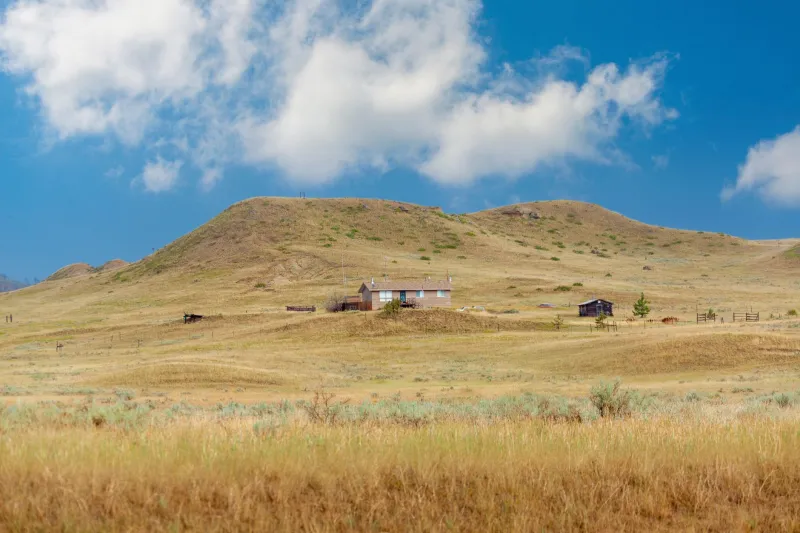
Montana is home to roughly 1.1 million people spread across 147,000 square miles — making it the fourth-largest state by area and one of the least densely populated. In dozens of rural counties, the nearest hospital is more than an hour away. Neighbor-to-neighbor check-ins that once defined small-town life have grown less frequent as younger residents leave for cities and older residents age in place. What remains constant, six days a week, is the mail carrier.
"We see things," said one carrier based out of Lewistown, who asked not to be identified by name. "A car that hasn't moved in three days. A dog barking at the door that won't stop. A light that's been on at two in the afternoon and two in the morning. You start to learn what normal looks like for every single house on your route, and when something's off, you feel it."
That accumulated knowledge — what researchers sometimes call "route intimacy" — has no formal training program behind it. It develops through years of repetition and human attention.
When the Route Is the Only Lifeline
The stakes are particularly high for Montana's aging rural population. According to the Montana Department of Public Health and Human Services, roughly one in five residents in many frontier counties is over the age of 65, and a significant portion live alone. For these individuals, weeks can pass without a visitor, a phone call, or any meaningful human contact.
Public health officials and county emergency managers have begun to acknowledge, quietly and sometimes reluctantly, that rural mail carriers function as an informal surveillance network for community welfare. Carriers have reported frozen water pipes threatening elderly residents' homes, spotted smoke from structural fires before 911 calls came in, and flagged households where prescription medications were going uncollected — a potential sign of medical crisis or death.
"They are, in practical terms, the eyes of the community," said a Fergus County emergency coordinator who works closely with local postal staff. "No other entity touches that many households, that consistently, across that kind of terrain."
What makes this arrangement both remarkable and fragile is that it exists entirely outside any official framework. Carriers receive no emergency response training, no additional compensation, and no formal protocol for what to do when they encounter a crisis. They act on instinct, experience, and conscience.
The Threat of Further Cuts
Against this backdrop, proposed reductions to rural postal routes have drawn alarm from community advocates, health workers, and local officials across the state.
The United States Postal Service has faced sustained financial pressure for more than a decade, and rural routes — which are expensive to operate and serve low mail volumes — have repeatedly appeared on efficiency review lists. Montana's congressional delegation has pushed back against proposed service reductions in the past, but the structural economics of rural delivery remain a persistent tension.
For communities where the mail carrier may be the only person guaranteed to check on a homebound resident, the prospect of reduced delivery frequency or route consolidation carries consequences that go beyond delayed packages.
"If you cut that route to three days a week, you're not just talking about slower mail," said a social worker based in Petroleum County, one of the least populated counties in the contiguous United States. "You're talking about a four-day window where nobody knows if someone has fallen, or run out of insulin, or had a stroke. That's a death sentence for some people out here."
Local officials have begun exploring whether formalized partnerships between postal services and county health or emergency management agencies could provide a more sustainable model — one that acknowledges the reality of what carriers already do and provides them with basic tools to do it more safely and effectively.
A Program Worth Watching
Some communities in other states have piloted programs that compensate carriers for structured wellness checks on vulnerable residents, funded through county health budgets or private grants. Montana has not yet adopted a comparable statewide initiative, though individual counties have explored informal arrangements.
Advocates argue that formalizing the role — with modest training in recognizing medical emergencies, clear reporting protocols, and appropriate liability protections — would cost a fraction of what a single emergency helicopter transport runs. In Montana, where air medical transport can cost tens of thousands of dollars and ground response times in frontier counties routinely exceed forty-five minutes, prevention carries enormous financial and human value.
For carriers like Deb Harwick, the policy debate feels distant from the reality of the road.
"I don't think of myself as a first responder," she said. "I think of myself as somebody who knows these people. I know their dogs' names. I know when their grandkids are visiting because there are extra cars in the driveway. I know when something isn't right."
She paused, looking out at a stretch of highway that disappears into the high plains.
"Out here, knowing somebody is everything. Sometimes it's the only thing standing between someone making it through the winter and not."
What Montana Stands to Lose
The conversation about rural postal service has long been framed around economics — cost per delivery, route efficiency, volume thresholds. What that framing consistently fails to capture is the human infrastructure that has quietly grown up around the daily mail run.
In Montana, where distance is a constant and community resources are stretched thin, the letter carrier's truck rolling down a gravel road at midday is more than a federal service. It is, for many residents, proof that someone out there is paying attention.
If those routes are reduced, consolidated, or eliminated, the mail will still eventually arrive. What may not arrive — not in time, and perhaps not at all — is the person who notices when something has gone wrong.