When There Is Nowhere Left to Turn: The Quiet Unraveling of Montana's Mental Health System
When There Is Nowhere Left to Turn: The Quiet Unraveling of Montana's Mental Health System
On a Thursday night last winter, a sheriff's deputy in Fergus County drove a man in mental health crisis more than 130 miles to the nearest available psychiatric facility. The man had not committed a crime. He was not under arrest. But there was no hospital bed closer, no crisis stabilization unit, and no clinician available to intervene. So the deputy drove, and the county paid the overtime, and the man sat in the back of a patrol vehicle for two and a half hours — frightened, unwell, and far from home.
This is not an isolated incident. Across Montana, law enforcement officers, emergency room nurses, and exhausted family members have quietly become the default mental health system for hundreds of thousands of residents. The formal infrastructure — the psychiatric wards, the community mental health centers, the outpatient counseling programs — has eroded to a point where many professionals working inside it describe it less as a safety net and more as a collection of fraying threads.
A State in Crisis, a System in Retreat
Montana has carried the burden of an elevated suicide rate for decades. The state routinely ranks in the top five nationally, with rates that dwarf the American average. In 2022, the most recent year for which complete data is available, Montana's suicide rate stood at more than twice the national figure. Among men between the ages of 25 and 54 — a demographic that defines much of rural Montana's working population — the numbers are particularly stark.
Yet at the precise moment when demand for mental health services has grown, the capacity to deliver them has contracted. The Montana State Hospital in Warm Springs, the state's only public inpatient psychiatric facility, has operated below its licensed bed capacity for years, hampered by chronic staffing shortages and deferred infrastructure maintenance. Community mental health centers across the state report vacancy rates for licensed clinicians that routinely exceed 30 percent. In some frontier counties, there is no licensed mental health provider of any kind within a reasonable driving distance.
"We have known for a long time that the system was underfunded," said one clinical director at a community mental health center in central Montana, who asked not to be identified by name. "What has changed is that there is no longer any cushion. There is no room to absorb a bad week, let alone a crisis."
The Geography of Despair
Montana's physical scale makes every healthcare problem harder, and mental health care is no exception. The state covers more than 147,000 square miles. Roughly a third of its counties qualify as frontier counties — defined federally as areas with fewer than six people per square mile. In those places, the concept of a nearby mental health clinic is largely theoretical.
For residents of communities like Jordan, Scobey, or Ekalaka, accessing outpatient counseling can mean a round trip of four to six hours. For those without reliable transportation — a population that overlaps significantly with people experiencing poverty, addiction, and mental illness — that distance is effectively impassable. Telehealth services have expanded since the COVID-19 pandemic, but broadband access remains inconsistent across much of rural Montana, and some providers report that patients in crisis are poorly served by a video screen rather than a human presence.
Waiting lists at functioning centers stretch for months. One Billings-area provider acknowledged that new patients seeking non-emergency outpatient therapy were being told to expect waits of ten to fourteen weeks. In Great Falls, a similar picture emerged. Helena's community mental health infrastructure has seen provider turnover rates that administrators describe as unsustainable.
Emergency Rooms Are Not Equipped for This
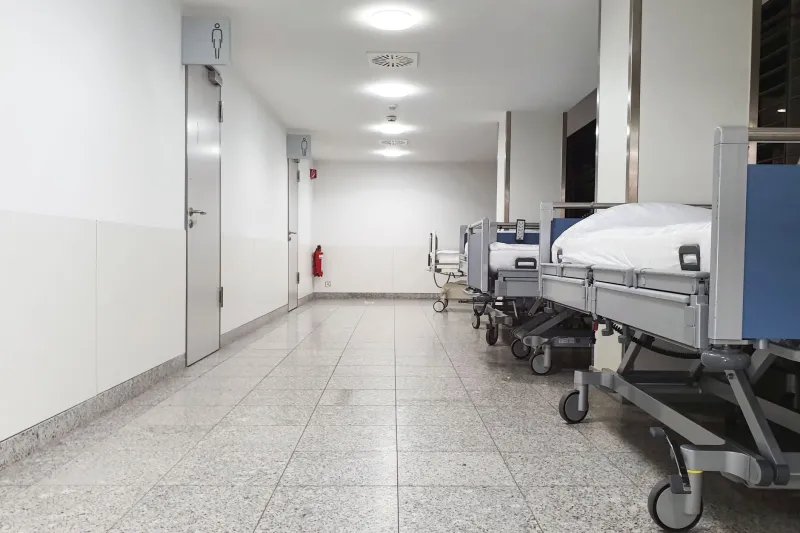
When the formal mental health system cannot absorb a patient, the emergency room becomes the default option. Hospital administrators across the state describe a phenomenon known as "boarding" — psychiatric patients who have been medically cleared but have nowhere to be transferred remaining in emergency department beds for days, sometimes longer, waiting for a psychiatric placement that may not exist.
The consequences ripple outward. Emergency rooms designed for acute medical care are not staffed or structured for extended psychiatric holds. Physicians and nurses trained in emergency medicine are placed in the position of managing conditions that require specialized expertise. Other patients in medical distress wait longer. Staff morale suffers.
"Emergency medicine was never designed to be a psychiatric holding facility," said a registered nurse at a regional hospital in eastern Montana. "But that is increasingly what it has become."
Law enforcement agencies report similar pressures. In Montana, officers responding to mental health calls can transport individuals to a hospital for evaluation under a civil commitment process known as an emergency detention. But with psychiatric beds scarce and emergency rooms strained, those transports often result in long waits, incomplete evaluations, and releases back into communities where follow-up care does not exist.
The Political Fault Lines
Montana's Legislature has not ignored the issue entirely. In recent sessions, lawmakers have debated and in some cases passed measures intended to expand access — including funding for crisis stabilization units and incentives for providers willing to practice in rural areas. Advocates credit those efforts as meaningful, if insufficient.
But the broader funding picture remains contentious. Montana's decision-making on Medicaid, which finances a substantial portion of mental health services, has been shaped by philosophical disagreements between legislative factions over the appropriate role of public funding in healthcare delivery. Provider reimbursement rates have not kept pace with the cost of operating a behavioral health practice, a factor that clinicians consistently cite as the primary driver of workforce shortages.
Some legislators have pushed for more aggressive investment in community-based care, arguing that the cost of the current system's failures — measured in emergency room visits, law enforcement hours, incarceration, and lost productivity — far exceeds what a properly funded prevention infrastructure would require. Others have questioned whether the state has the fiscal capacity to expand services at the scale advocates propose, particularly against a backdrop of competing budget priorities.
Meanwhile, families navigating the system describe an experience of bureaucratic exhaustion layered on top of personal crisis.
What Families Are Left to Carry
In Cascade County, a mother spent three months attempting to connect her adult son with inpatient psychiatric care following a serious episode of psychosis. She made dozens of phone calls. She drove him to two different emergency rooms. She filed paperwork with county officials. She waited.
"Nobody told me there was nothing available," she said. "They just kept transferring me, or putting me on hold, or telling me to try somewhere else. You start to feel like the system is designed to make you give up."
Her son eventually received care — not through any coordinated system response, but because a county attorney intervened personally on her behalf. She considers her family fortunate.
For others, the wait ends differently. Montana's suicide statistics are not abstractions. Behind each number is a family, a community, and a system that, on that particular day, did not have anything left to offer.
A Reckoning Overdue
Montana's mental health crisis did not develop overnight, and it will not be resolved in a single legislative session. But the consensus among clinicians, administrators, law enforcement leaders, and family advocates is that the trajectory is moving in the wrong direction — and that the distance between the state's mental health needs and its capacity to address them is growing, not shrinking.
The question facing Montana's political leadership is not whether the system is failing. The evidence on that point is considerable and consistent. The question is whether the will exists to rebuild it before the costs — human and financial — become impossible to ignore.