More Than Nails and Lumber: The Family Hardware Stores That Still Hold Montana's Small Towns Together
On a Tuesday morning in late March, a rancher from outside of Roundup walked into Hartley's Hardware on Main Street with a cracked irrigation coupling in one hand and a look of quiet desperation on his face. Spring planting was weeks away, and the nearest big-box home improvement store was more than ninety miles down the road. Within twenty minutes, proprietor Dale Hartley had identified the fitting, located a comparable replacement from a bin in the back room, and talked the rancher through a temporary repair that would hold until the proper part arrived by freight.
No search engine found that solution. No algorithm suggested it. Dale Hartley knew it because he has been solving problems like that one for thirty-one years.
Scenes like this play out in a shrinking number of Montana communities every single week—quiet transactions that are as much about knowledge transfer as they are about commerce. But the stores where they happen are disappearing, and the question of what replaces them is one that rural Montana has not yet found a satisfying answer to.
A Different Kind of Inventory
Family-owned hardware stores have never competed with national chains on price. They have never tried to. What they offer instead is something harder to quantify: accumulated, place-specific expertise that is calibrated to the particular demands of rural Montana life.
The staff at a small-town hardware store typically know which well pumps hold up in the county's groundwater chemistry. They know which exterior paints last through a northeastern Montana winter and which ones begin peeling by October. They know which local contractors are reliable and which ones are not. That kind of institutional knowledge, built over decades of serving the same community, cannot be replicated by a warehouse staffed with minimum-wage employees reading from product cards.
"People don't come in here just to buy a bolt," said Connie Wexler, who has operated Wexler Supply in Harlowton with her husband since 1998. "They come in to figure out what bolt they need, why the old one failed, and how to make sure it doesn't happen again. That's a conversation, not a transaction."
For many rural Montanans, that conversation is the difference between a workable fix and a costly, time-consuming trip to the city.
The Economics of Staying Open
The financial realities facing independent hardware retailers are not gentle. Wholesale costs have climbed steadily over the past decade. Fuel surcharges on freight deliveries add up quickly for stores that rely on suppliers based in Billings, Great Falls, or beyond. Meanwhile, online retailers and regional chains offer prices that small operators simply cannot match.
According to the North American Hardware and Paint Association, the number of independent hardware stores operating in the United States has declined by roughly forty percent since the early 1990s. Montana, with its sparse population and long supply chains, has felt that contraction acutely.
Several communities that once supported two or three hardware stores now have none. In those towns, residents describe a cascade of inconvenience that extends well beyond the inability to buy a box of screws locally. Emergency repairs become logistical ordeals. Tradespeople who once could source materials quickly now schedule work around delivery windows. Elderly residents without reliable transportation face the steepest disadvantages.
"When the hardware store closed in our town, it wasn't just a business that left," said one Fergus County resident who asked not to be named. "It was a whole way of handling problems. Suddenly everything took longer and cost more."
The Gathering Place Function
Beyond their commercial role, these stores serve a social function that is rarely discussed in economic analyses but is deeply understood by the communities that rely on them. The counter at a family hardware store is one of the last genuinely public spaces in many small Montana towns—a place where farmers, contractors, retirees, and newcomers share the same few feet of floor space and, often, the same conversation.
Information moves through those spaces in ways that matter. Word of a neighbor's illness. News of a job opening at the elevator. A warning about road conditions on a particular county route. Hardware stores, like barbershops and diners before them, function as informal community bulletin boards, and their absence creates a silence that is felt even by people who rarely bought anything there.
Dale Hartley estimates that on any given weekday, at least a third of the people who come through his door are not there to purchase anything specific. "They're just checking in," he said. "And I think that matters more than people realize."
Succession and the Question of What Comes Next
Perhaps the most pressing concern facing Montana's independent hardware stores is not competition from online retailers but the challenge of succession. A significant share of the state's remaining independent operators are in their sixties or seventies, and finding buyers willing to take on a low-margin, labor-intensive business in a small town is genuinely difficult.
Connie Wexler has begun having conversations with her adult children about the future of Wexler Supply. None of them currently plan to take over the business. She understands their reasoning, even as she hopes something will change.
"This store is our life's work," she said. "But I can't ask someone to sacrifice twenty years of their life for something that might not pencil out. That's not fair to them."
Some communities have explored cooperative ownership models as a potential path forward, pooling local investment to keep a store running even when no single buyer emerges. A handful of towns in other rural states have had modest success with this approach, though it requires a level of civic organization and capital commitment that is not always available.
State economic development offices have shown limited interest in addressing the issue directly, viewing retail succession as a private-sector matter. Community advocates argue that framing misses the point entirely.
What the Shelves Hold
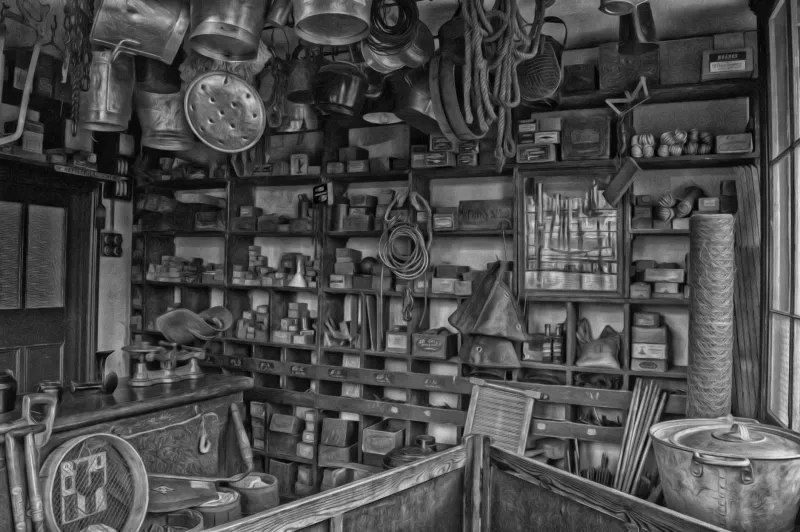
Walk through Hartley's Hardware on a weekday afternoon and you will find the kinds of items that tell a specific story about where you are: baler twine, stock tank heaters, fence stretchers, seed-starting trays, bear spray, and a wall of specialty fasteners organized in a system that only Dale Hartley fully understands. It is an inventory assembled not from a corporate planogram but from thirty-one years of listening to what people actually needed.
That responsiveness—to season, to local industry, to the particular problems that arise in a particular place—is what makes a family hardware store something other than a retail outlet. It is, in a meaningful sense, a record of how a community survives.
The question Montana now faces is whether it values that record enough to preserve it, or whether it will allow it to quietly close, one store at a time, until the knowledge locked inside it is simply gone.